















Cattle worm resistance is affecting more farms - how can you check your status and protect your cattle?

This is branded content for Zoetis
The high prevalence of anthelmintic resistance in sheep within Australia has been recognised by producers for many years.
SheepTRAX, Australia's largest ongoing assessment of drench efficacy in sheep, discovered 70 per cent of farms have worms that have established resistance to three or more active ingredients in drenches.
When it comes to cattle, most producers are unaware that anthelmintic resistance in cattle is no longer an emerging issue but is now a real concern. Today, we are seeing drench-resistant parasites impacting the productivity of cattle in different production systems all over Australia.
Dr Matthew Playford, a veterinary parasitologist withmore than 30 years of experience in this field, and the owner of Dawbuts, an independent parasitology laboratory, stated that, "Our lab processes hundreds of cattle tests per year and we are seeing more and more evidence that resistance is spreading and becoming more severe. The problem is so bad on some farms that a drench just doesn't have any impact on the worms".
Research conducted in Australia over the last couple of years has confirmed all major production limiting species of worms (Cooperia, Haemonchus and Ostertagia) have demonstrated resistance to our most heavily relied upon drenches, the macrocyclic lactones (the 'mectins') plus other classes of drench. These findings are not limited to one geographical region or climatic zone.
Anthelmintic resistance is a genetic trait of resistant worms that allows them to survive drench treatments which were previously shown to be effective. It occurs as a result of selection over time by the small population of worms that are inherently able to survive treatments. It is commonly associated with frequent use of chemicals within the same chemical class, underdosing due to poor estimation of weights, poor technique, not calibrating equipment prior to use or drenching cattle unnecessarily.
The way we administer drench also impacts the rate of resistance development. The use of pour-on products results in variable dosing of animals. Some of the pour on product is absorbed across the skin and some is absorbed by licking the product off themselves and other cattle. Therefore, the licking behaviours of different cattle can also result in underdosing and therefore should ideally be reserved for scenarios when facilities for cattle handling are poor and human safety is a concern. Injectable or oral drenches are the most effective way to deliver consistent dosing to cattle.
To manage anthelmintic resistance on farm, Dr Playford advises that producers should be performing, "routine faecal worm egg count (WEC) as a monitoring tool to assess the need for drenching". Worm egg counts are correlated with the total number of worms in the animal, and this in turn is correlated with the production losses which occur. Low worm burdens produce little impact on cattle, whereas high burdens rob cattle of daily weight gain, feed conversion efficiency, milk production and in the worst-case scenario can kill cattle.
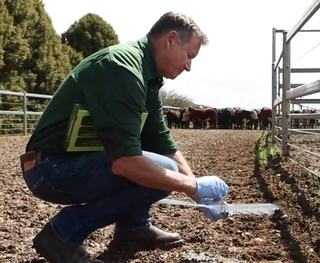
Additional to WEC monitoring, farmers should be keeping track of drench efficacy with simple 'before and after' drench tests.

Drench checks are performed by collecting samples for a WEC on Day 0 (day of drenching) and then again 14 days later. Dung samples are cultured and the remaining worms identified. The WEC obtained can then be used to estimate the percentage of each type of worms killed by a treatment.
A benchmark of 95 per cent efficacy is used to indicate whether a drench is performing at an appropriate level of efficacy and to identify resistance. Knowledge is key and more diagnostic testing is warranted, so speak with your local animal health advisor or laboratory for advice. WECs have historically been thought to have variable reliability in cattle however more sensitive tests are now available which make them highly useful for monitoring cattle worm burdens.
When drenching on your property, all producers should be considering the below key points from our industry experts at Paraboss.
- Young stock, and cattle under nutritional stress or metabolic stress are more susceptible to worms. Most, if not all cattle will require a drench at weaning.
- High stocking rates, especially in wet and warm conditions will favour larval development from eggs and hence increase the exposure of cattle to worm populations. Larval survival on pasture is maximum during the cooler months.
- Drench only when necessary so perform routine WEC to assess need, especially in adult cattle.
- Ask for sensitive tests - those with a sensitivity of 20epg or below.
- Use an appropriate drench - a drench with at least 95 per cent efficacy on your farm.
- Combination products containing actives from different chemical classes that target the same parasites will have greater efficacy (unless the worms present are 100 per cent susceptible to the drench) as the two actives will have different modes of actions to maximise effect. Combination products also delay the onset of resistance as fewer resistant worms are able to survive treatment.
- Oral and injectable anthelmintics are considered best practice as they provide higher and less variable blood levels of the chemical than do pour-ons. Oral products however are less likely to achieve high concentrations in the tissues such as the intestinal wall and skin compared to injectable products.
- Long-acting products should be used with care as they are likely to increase the levels of resistance (as they have with sheep).
- When treating external parasites like ticks and lice, consider products specific for this purpose if worm control is not also required at the same time.
- Always use a quarantine drench, i.e., combination products, when purchasing cattle to minimise the introduction of resistant worms onto your property.
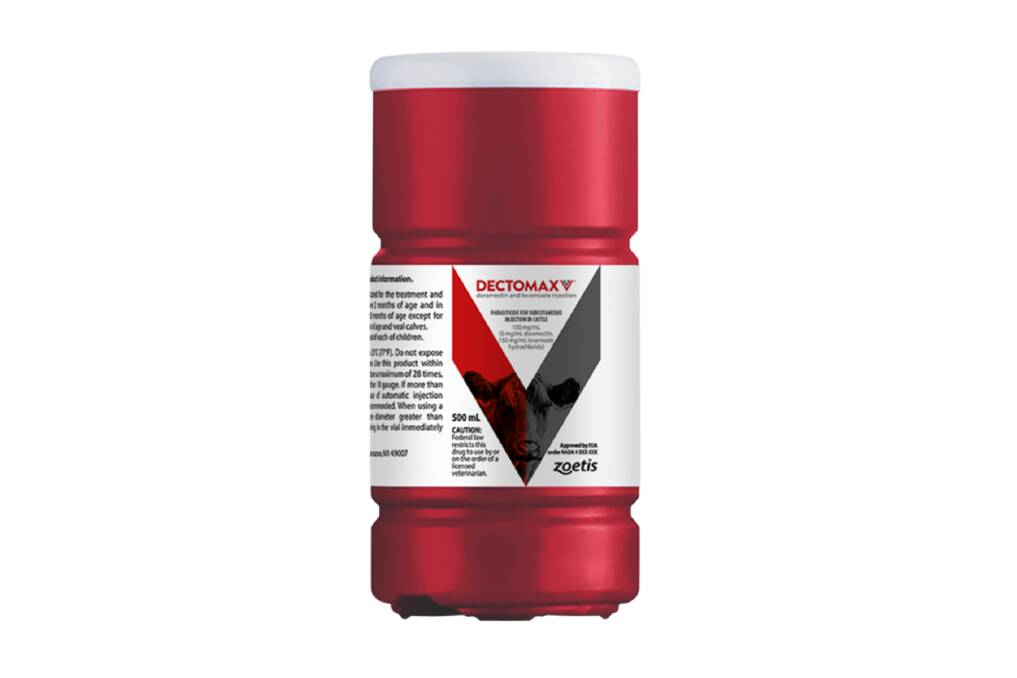
Dectomax V - Australia's first injectable dual active drench
Dectomax V injection is ideal for all weaners and young, growing cattle which are most economically impacted by worms. Given its very high treatment efficacy, Dectomax V is ideal as a quarantine/induction drench to prevent resistant worms entering a farm with brought in stock. Dectomax V has been compared to leading drenches in Australia and the results were outstanding with an overall mean efficacy of 99.7 per cent across 21 studies.
Dectomax V can also be used in replacement breeding stock, such as replacement heifers and in adult cattle. It is an ideal product for use on entry to backgrounding and at induction prior to feedlot induction to ensure resistant worms don't hinder weight gain.
Providing high efficacy, this broad spectrum parasiticide with Dectomax V's dual active technology is designed to kill the most damaging parasites, including resistant worms. Easy injectable administration results in highly reliable dosing. In addition to treating gastrointestinal worms, it also controls cattle tick and sucking lice.
This is branded content for Zoetis
